
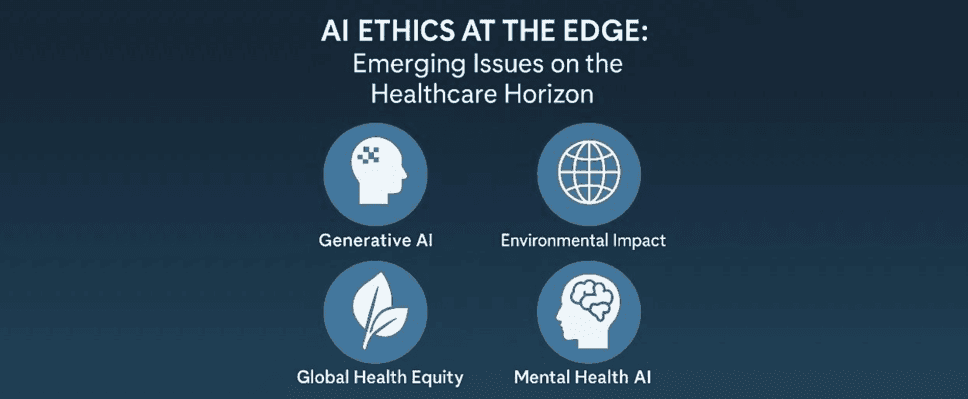
AI Ethics at the Edge: Emerging Issues on the Healthcare Horizon
Fri Feb 27 2026
Synod Intellicare
Over the past several months, we have followed ethical AI in healthcare from invisible bias to readiness, transparency, regulatory accountability, and the human work of real-world adoption. Each step asked a grounded question: How do we make AI fair, explainable, governable, and truly usable at the bedside?
In February, the questions get harder. As new technologies race ahead - generative AI for clinical documentation, large models embedded in patient-facing tools, always-on monitoring apps - the horizon of ethical risk is shifting. These systems do not just assist clinicians; they may write their notes, speak with their patients, and shape how care is delivered in subtle but powerful ways.
This piece looks at ethical AI at the edge: the emerging issues that sit just beyond today’s deployment frameworks, but are already arriving in clinics, homes, and health systems.
From Clinical Decision Support to Generative Companions
Most of the past decade’s healthcare AI debate has focused on risk scores, diagnostic models, and triage tools - systems that produce a probability or a recommendation. Today, a new category is accelerating into view: generative AI in medicine, including large language models used for draft clinical notes, patient education materials, or even conversational agents that answer questions in portals and apps.
These tools can reduce documentation burden and improve access to information, but they also introduce distinct risks:
- Hallucinations and subtle inaccuracies can slip into clinical notes or patient messages, potentially propagating errors through the record.
- Privacy and data protection become more complex when prompts and context windows contain identifiable patient information, especially if models are hosted or trained in environments outside the organization’s direct control.
- Shifts in clinician - patient communication may occur if generative systems begin to mediate how empathy, reassurance, or risk are conveyed.
Early research in digital health suggests that explainability alone is not enough; systems must be designed so that clinicians can detect when generative outputs may be wrong and correct them before harm occurs. As Ghassemi and colleagues argue, superficial explanations can create false confidence without revealing real weaknesses, especially in complex models.
At Synod Intellicare, our stance is simple: generative AI in clinical contexts should extend, not replace, human judgment and communication. That means keeping clinicians firmly “in the loop,” designing interfaces that highlight uncertainty instead of hiding it, and ensuring that generated text is traceable, editable, and auditable before it becomes part of the permanent record.
AI’s Environmental Footprint: Hidden Costs in the Cloud
Ethical AI conversations often focus on fairness and bias, but another dimension is gaining attention: the environmental footprint of large models. Training and running high-parameter systems can consume substantial energy and water, particularly when hosted in large data centers.
For healthcare organizations that have committed to climate targets or signed on to decarbonization initiatives, this is not an abstract concern. It raises practical questions:
- How much energy does our AI infrastructure consume compared with other clinical IT systems?
- Can we justify deploying very large models if smaller, well-calibrated models provide comparable benefit for our patient population?
- Should environmental impact be part of procurement criteria for AI vendors serving hospitals and health systems?
The emerging literature on sustainable AI argues that environmental stewardship should be treated as part of ethical risk management, not a separate conversation. For us, this means optimizing model size and deployment patterns where possible, favouring architectures that are performant enough rather than maximalist, and encouraging partners to consider environmental metrics alongside fairness and accuracy.
Ethical AI, in our view, is not only about who benefits and who is harmed, but also about how our tools draw on shared planetary resources.
Global Health Equity: Will Advanced AI Widen or Narrow the Gap?
The landscape review highlighted a growing concern: advanced AI could either widen or narrow existing global health inequities, depending on how it is developed and deployed. High-resource systems with robust data infrastructure, specialized staff, and regulatory capacity may be able to adopt sophisticated models safely and quickly. Low-resource settings, by contrast, face infrastructure constraints, data gaps, and fewer technical safeguards.
Several open questions follow:
- Will cutting-edge AI tools primarily benefit populations already well-served by healthcare systems?
- Are models trained mostly on data from North America and Europe being applied to populations with different disease patterns, social determinants, and care pathways?
- How can international collaborations - such as those convened by the World Health Organization and regional public health networks - ensure that equity is a design requirement, not an afterthought?
Research on bias in population health algorithms has already shown how inequity can be embedded in seemingly neutral tools. Obermeyer and colleagues, for example, demonstrated that a widely used risk algorithm systematically underestimated the needs of Black patients because it relied on historical cost data rather than underlying health status.
Extending this lesson to global deployments, ethical AI at scale must avoid exporting biases from one context into another. That means:
- Involving clinicians, patients, and researchers from low- and middle-income countries in model design and validation.
- Evaluating performance across diverse subpopulations before declaring a model “generalizable.”
- Supporting capacity-building so that local teams can interpret and govern AI tools rather than relying entirely on external vendors.
For Synod Intellicare, this horizon question connects back to our core mission: helping organizations confidently deploy AI applications free of hidden bias and with strong transparency and governance, whether they serve one hospital or an entire health region.
Mental Health AI: When Vulnerability Meets Automation
Among the most delicate frontiers is AI in mental health - from chatbots that provide supportive conversation, to decision-support tools that flag suicide risk, to apps that monitor behaviour signals
via smartphones. The promise is real: expanded access, earlier detection, and more continuous support between visits.
But the risks are uniquely human:
- People engaging with mental health tools are often in moments of vulnerability, crisis, or isolation.
- Misclassification - missing a high-risk case or over-flagging a low-risk one - can have profound clinical and personal consequences.
- Trust can be fragile; a single harmful or insensitive interaction can undermine not only the tool, but the broader system of care.
Work in digital phenotyping and AI-enabled mental health screening underscores the need for stronger guardrails, including clear escalation pathways to human clinicians, transparency about what data is monitored, and strict limits on secondary uses of highly sensitive information.
Our view is that mental health AI should be held to a higher standard of consent, oversight, and humility than many other domains. These tools should support therapeutic relationships, not replace them; they should augment human empathy, not simulate it without accountability.
Proactive Ethics: Guidelines Before the Headlines
One theme across these emerging issues is timing. Too often, ethical debate follows after a crisis, a headline, or a regulatory breach. For generative AI in medicine, environmental impacts, global deployments, and mental health tools, waiting for harm to surface is not acceptable.
The landscape review points to a growing body of global guidance - from WHO recommendations on AI in health to EU and Canadian regulatory efforts - calling for proactive ethical governance before mainstream deployment.
At Synod Intellicare, we interpret this as a call to:
- Design fairness, transparency, and environmental awareness into systems from the outset, not as retrofits.
- Provide decision-makers with practical, clinically relevant dashboards that make emerging risks visible and actionable.
- Support healthcare organizations in conducting impact assessments that include bias, safety, environmental, and equity dimensions, especially for high-impact use cases.
The same principles that guided our work on fairness auditing and readiness - visibility, governance, and human oversight - are now being extended to these emerging modalities.
Connecting the Arc: From Today’s Tools to Tomorrow’s Questions
Since September, our thought leadership series has moved through five stages:
- September: Making bias visible in existing AI systems and datasets.
- October: Building organizational readiness for fair and accountable AI deployment.
- November: Enabling transparency so clinicians can understand and challenge AI reasoning.
- December: Embedding regulatory accountability and governance from design through deployment.
- January: Focusing on the human work of adoption - trust, culture, and change management at the bedside.
February adds a sixth dimension: looking ahead. We ask not only whether today’s tools are fair and trustworthy, but whether tomorrow’s innovations - generative systems, large models, global deployments, and mental health applications - will be guided by ethical frameworks robust enough to protect the people they touch.
For us, this is not a purely speculative exercise. It shapes how we design our own platforms, select partners, and prioritize research. It reminds us that ethical AI is not just about fixing yesterday’s models; it is about choosing which futures we are willing to build.
A Closing Reflection
Ethical AI at the edge is challenging because it forces us to hold two truths at once:
- We need innovation to address real gaps in access, equity, and quality.
- We need restraint and reflection to ensure that new tools do not deepen the very inequities we hope to heal.
As we continue our work at Synod Intellicare, our commitment is to stay grounded in both realities - to be excited about what is possible, and humble about what is at stake.
The horizon is not something that happens to us. It is something we co-create, through each design decision, deployment choice, and partnership we make.
References:
Cross, J. L., Choma, M. A., & Onofrey, J. A. (2024). Bias in medical AI: Implications for clinical decision-making. PLOS Digital Health, 3(11), e0000651.
Dankwa-Mullan, I., Winkler, V., Parekh, A. K., & Saluja, J. S. (2024). Health equity and ethical considerations in using artificial intelligence for public health. Preventing Chronic Disease, 21, E47.
European Commission. (2024). Regulation (EU) 2024/1689 of the European Parliament and of the Council of 1 June 2024 on artificial intelligence (AI Act). Official Journal of the European Union, L 188/1–L 188/119.
Ghassemi, M., Oakden-Rayner, L., & Beam, A. L. (2021). The false hope of current approaches to explainable artificial intelligence in health care. The Lancet Digital Health, 3(11), e745–e750.
Obermeyer, Z., Powers, B., Vogeli, C., & Mullainathan, S. (2019). Dissecting racial bias in an algorithm used to manage the health of populations. Science, 366(6464), 447–453.[2]
World Health Organization. (2021). Ethics and governance of artificial intelligence for health. World Health Organization.
💼 Follow us on LinkedIn: Synod Intellicare
✖️ Follow us on X: Synod Intellicare